
OUR SERVICES
Retail Transformation Program
121 CONSULTING transforms existing retail businesses and develops new retail networks. We work on national and regional projects both in Russia and internationally.
What enables us to identify and understand our clients’ pain points and propose effective solutions?
Our experts bring many years of senior-level experience in retail and FMCG, together with a track record of dozens of successfully delivered retail transformation projects, including international engagements.
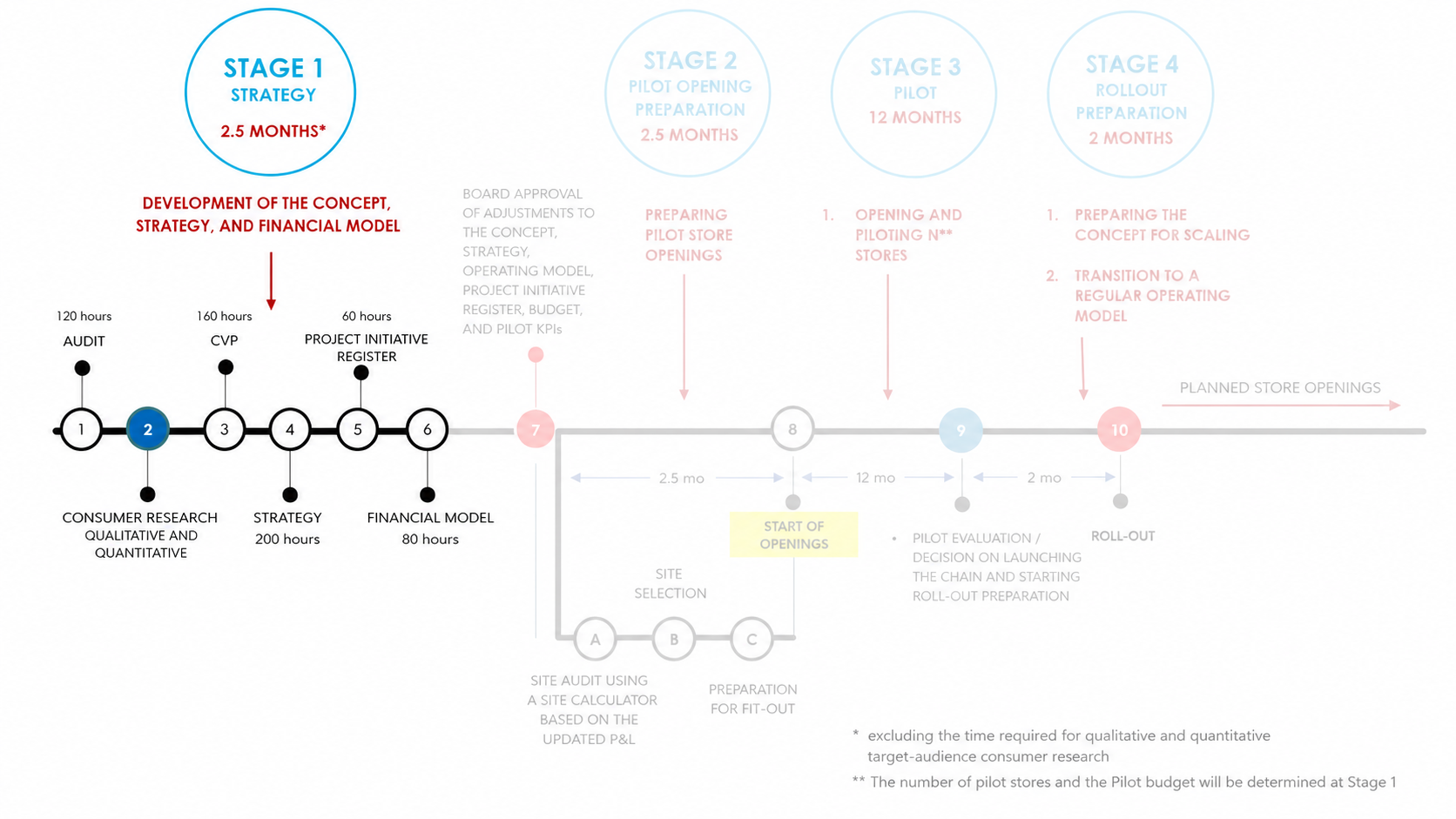
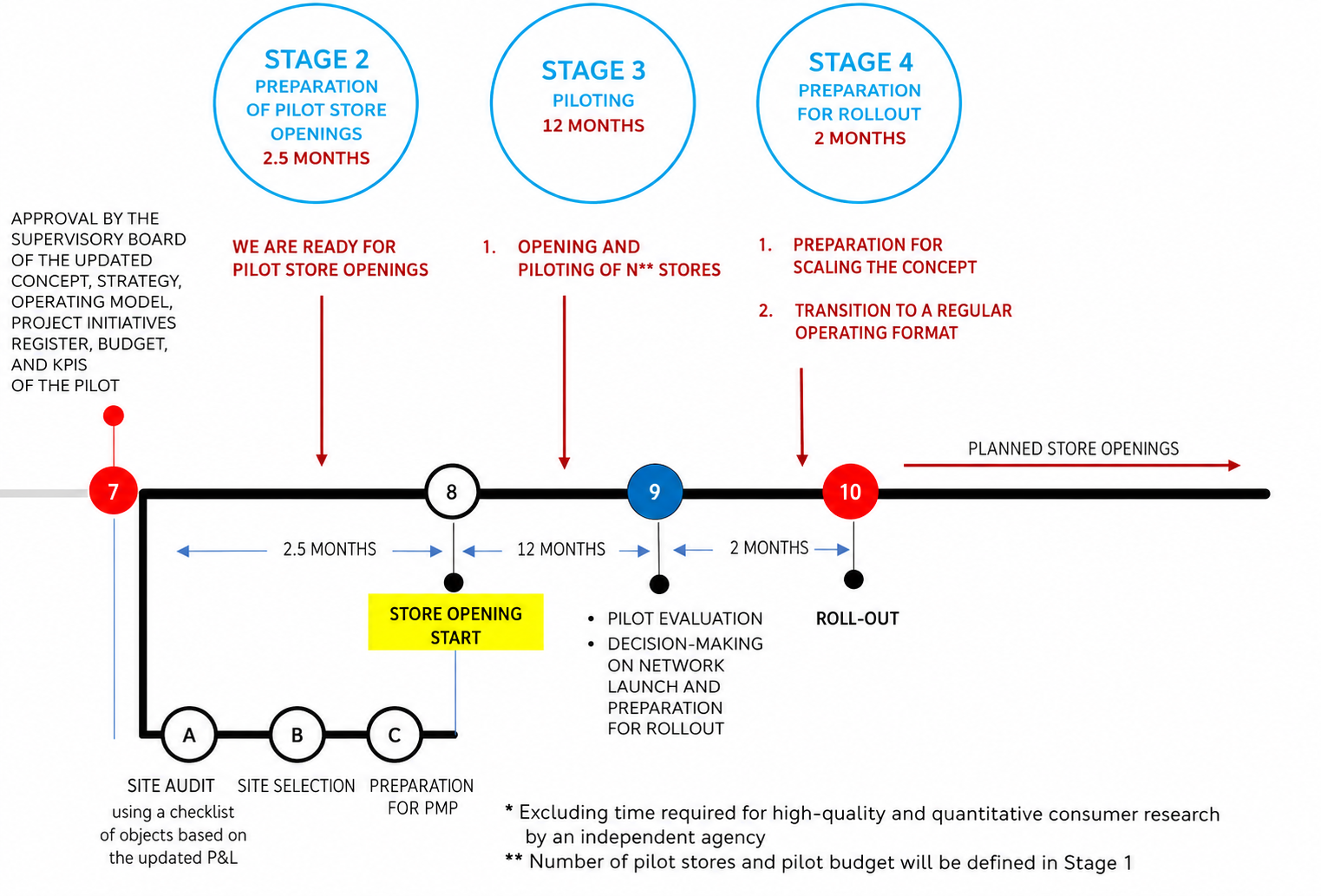
We have developed an effective, stage-based approach. We begin with an audit of the existing business, in-depth market and consumer research, and the development of a customer value proposition — the CVP (Customer Value Proposition) — for the new format, followed by a business implementation strategy.
The strategic phase concludes with a detailed portfolio of project initiatives and a financial model for the new format.
The financial model validates the new format’s expected EBITDA impact, provides the basis for a business transformation roadmap, and enables implementation to begin.
The KPIs for a new-format transformation project typically include not only market share and financial growth targets, but also target improvements in NPS.
Launching New Stores
Following the retail transformation phase and the development of a new CVP, we help clients implement the project.
Two engagement models are available:
FORMAT 1
Project Support
We provide ongoing advisory and consulting support throughout project implementation.
FORMAT 2
Project Delivery
Our experts work in-house with the retail company, temporarily taking on the necessary roles within the client’s organization. Importantly, the project is supported or delivered by the same experts who conducted the audit and developed the transformation strategy.
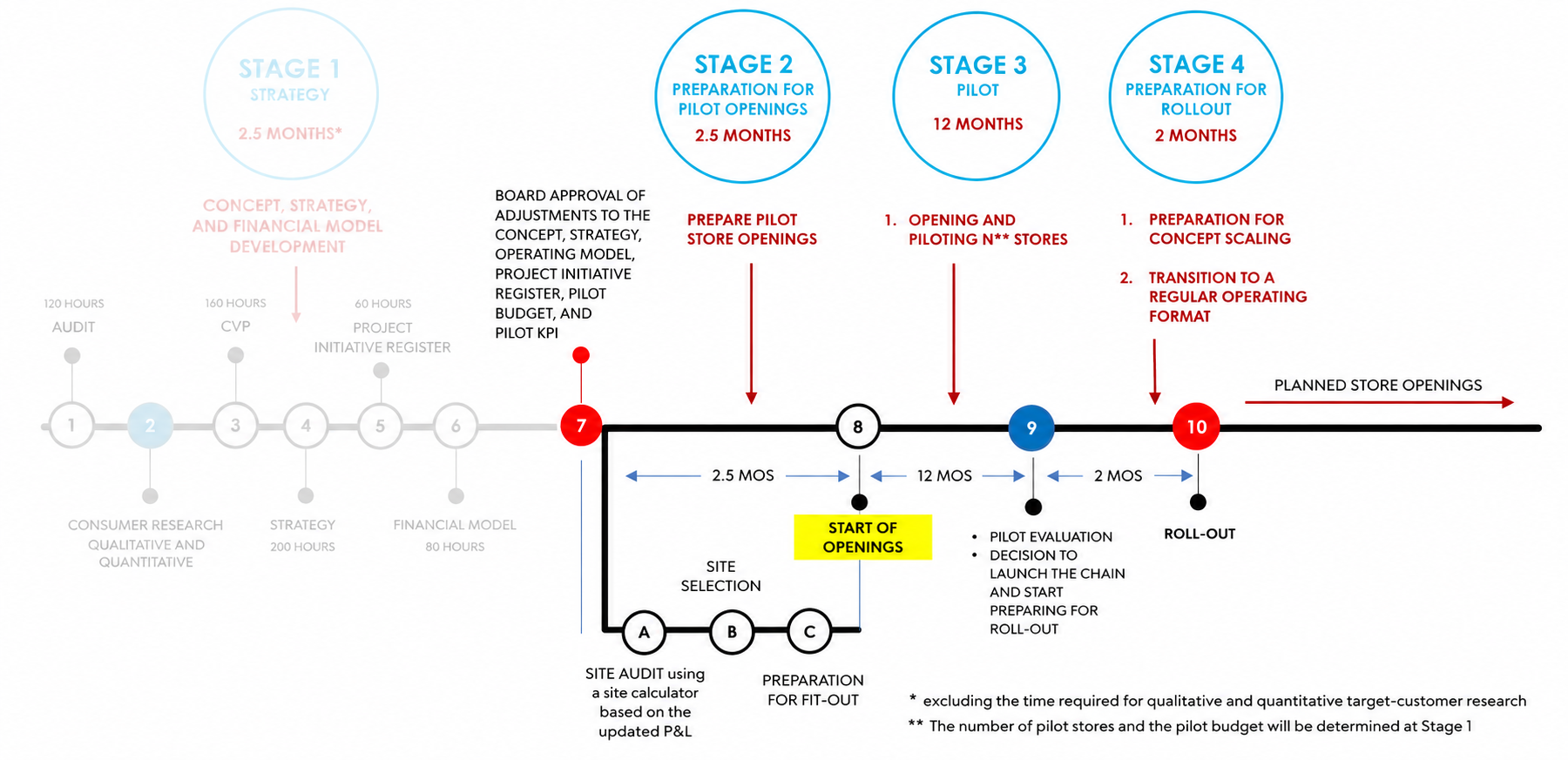
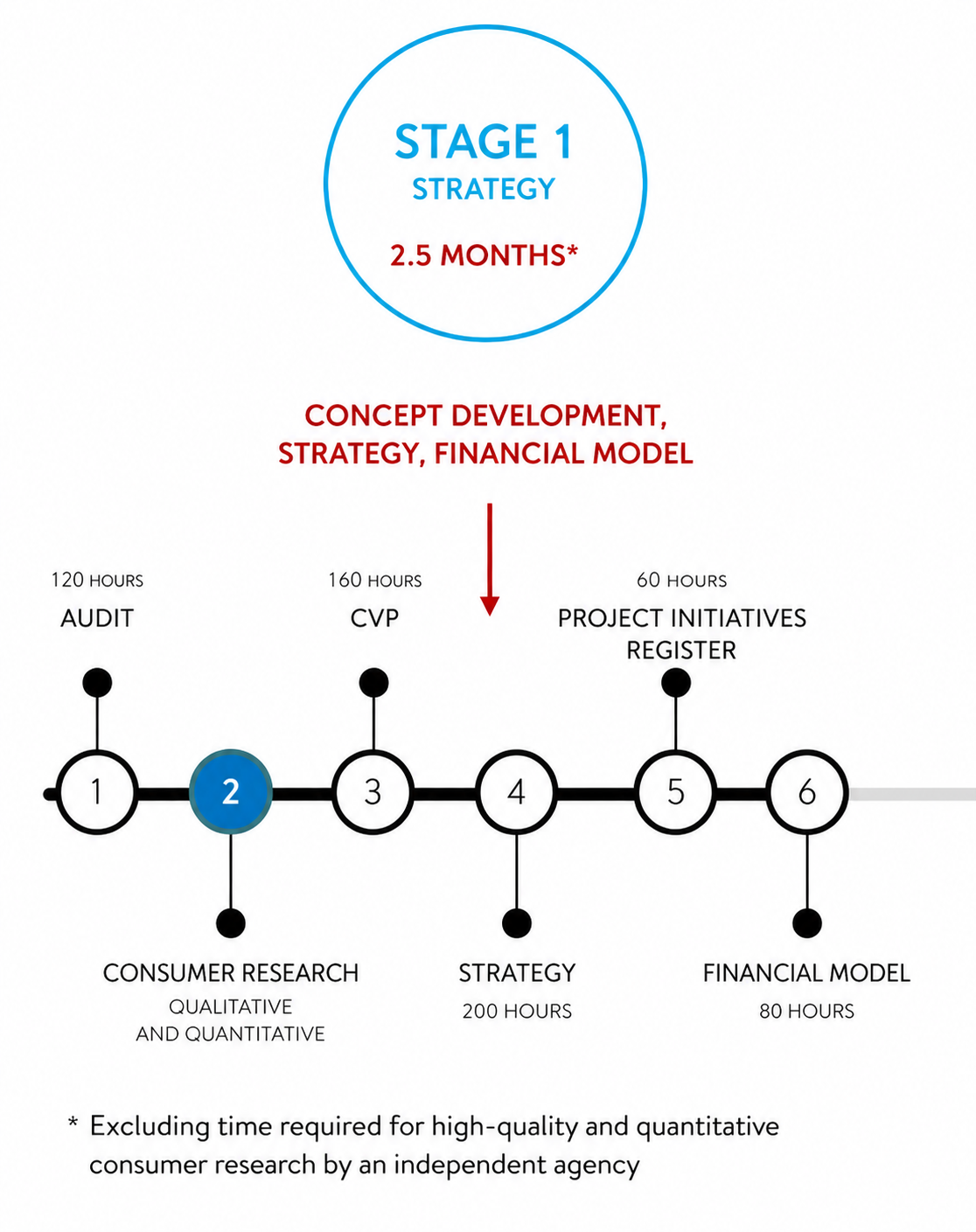
Project stages: piloting the new format, assessing pilot performance, preparing the financial analysis required to decide on network launch and roll-out, scaling the format, and transitioning to regular operations.
Retail Transformation Outcomes
STAGE 1
Results
1. A clear understanding of the concept and its growth potential
- We understand the competitive landscape, the competitive strategy, and the target operating model.
- We understand the target customer.
- We define the concept and CVP — what the store should offer and how it should operate so that customers choose it:
- Look and feel
- Assortment: number of SKUs, key categories, price segments, and private-label products
- Pricing: competitive pricing, promotional pricing, margin targets, and the methods used to achieve them
- Loyalty programme and communications plan
- Services and staffing
- Supply chain and operations: automated ordering and replenishment, as well as on-shelf availability management.
- Site requirements, including traffic, external appearance, compliance with building regulations, electrical capacity, water supply, ventilation, restrictions related to alcohol and tobacco licences, and other factors.
- Operational staffing requirements: how many people should work at each location per shift, which roles are required, how many shifts are needed, which processes are performed, by whom and when, and how performance is monitored and achieved.
2. A complete portfolio of network-development initiatives
All initiatives required to build the network are defined and developed, with assigned owners, timelines, budgets, objectives, and KPIs.
3. Store P&L and site-selection calculator
A store-level P&L model and a site-selection calculator developed on its basis.
4. Financial model
A complete financial model for the pilot and the overall project.
Launching New Stores
STAGE 2
Results
- Full readiness for store openings.
- The supplier base for the revised assortment matrix has been defined, with full readiness to commence deliveries.
- The storage, delivery, and replenishment model for pilot stores has been established, including replenishment frequency and order quantities. The supply chain is ready to support both offline and online operations.
- The required store staffing structure and team composition have been defined. Employees are recruited and ready to begin work in the stores.
- The customer communication, acquisition, and retention strategy has been developed, with full readiness to begin building the demand funnel.
STAGE 3
Results
- N pilot stores have been opened and operated for at least six months.
- The concept’s business model has been refined, including the assortment, pricing, operating technologies, equipment package, business processes, supply chain, operations, partnerships, and other key elements.
- The network expansion strategy has been refined to reflect regional consumption patterns and purchasing power.
- The financial model and investment payback period have been updated based on the pilot stores’ actual sales performance.
- An NPS survey has been conducted to assess how attractive the concept is to the target audience.
STAGE 4
Results
1. Based on the pilot results and achieved KPIs, the following have been refined:
- Growth strategy
- Operating model, including replenishment, control and maintenance of on-shelf availability (OSA), payroll costs for operational staff, and optimized supply chains
- Store concept and specification, including construction, fit-out, equipment, consumables, and other requirements
- Assortment matrix and pricing approach, including customer baskets, price segments, inventory turnover, and SKU-level revenue and margin targets. Supplier and/or distributor negotiations have been completed, volumes have been aligned with the sales budget, suppliers have been selected, commercial terms agreed, and supply contracts signed
- Marketing communications designed to attract new customers effectively and retain existing customers, increasing visit frequency, average transaction value, and basket diversity. Agreements have been signed with the principal media platforms
- Sales budget, including margin, inventory turnover, and net-profit targets
- Store-opening schedule and construction contractors selected through a tender process
2. Equipment supply contracts have been signed in line with the store-opening schedule.
3. The team has been trained and is ready for roll-out. An effective training and motivation system has been implemented.
FROM VISION — TO ACTION. FROM TEAM ALIGNMENT — TO STRATEGY.
Strategic Session
WHAT IT IS
A strategic session is a management tool that helps shareholders and senior leadership develop a shared vision, align goals, and turn strategy into a concrete action plan.
The 121 Consulting team supports the client throughout the entire process — from diagnostics and data preparation to facilitation, decision documentation, and the launch of a project management office.
WHEN A STRATEGIC SESSION IS NEEDED
- when shareholders or the management team change;
- when priorities and strategic KPIs need to be aligned;
- when developing a three-year business growth strategy;
- before launching a new business model, format, private label, or entering a new region;
- during periods of crisis, to restore focus and align key initiatives.
HOW IT WORKS
(2–4 WEEKS)
Preparation
Business diagnostics, data collection, and identification of key growth opportunities.
- interviews with shareholders and key executives
- analysis of data, financial models, and operational KPIs
- preparation of the shareholder memorandum and discussion scenarios
(1–2 DAYS)
Session Delivery
Development of an aligned strategy and transformation roadmap.
- facilitation by 121 Consulting
- work in cross-functional groups
- goal structuring, SWOT and premortem analysis, and roadmap development
(2–3 WEEKS)
Support
Support with implementing decisions and achieving the agreed objectives.
- session minutes, roadmaps, and functional strategies
- integration into the financial model and PMO dashboard
- implementation support and progress monitoring
Results
- an aligned strategy for the next 1–3 years;
- functional roadmaps and an initiative portfolio;
- a KPI framework and a unified budgeting format;
- stronger team engagement and greater alignment across management.
Examples of Strategic Sessions and Engagement Formats
Every strategic session concludes not with discussion, but with a set of concrete decisions, an implementation roadmap, and a clear format for the next stage of work.
Selected Sessions
Examples of strategic sessions and business transformation projects delivered by our team.
- Pobeda retail chain — efficiency and format strategy for Prodmag and Prodsklad
- Gulliver retail chain — differentiated growth strategy and CVP transformation
- Tvoya Apteka retail chain — retail network format development strategy
Engagement Formats
Flexible ways of working depending on the objectives, scale of the challenge, and required level of support.
- Lite — one-day facilitation for rapid alignment on objectives
- Full — two-day session with preparation of a memorandum and financial model
- Extended — followed by PMO implementation, KPI dashboards, and ongoing support
— Partnership
When to Work With Us
Consider working with us if:
- your retail concept is not scalable
- pilot stores are underperforming
- operating processes vary from one location to another
- the strategy exists but is not being implemented
- expansion decisions are made without reliable data